Teaching
Teaching
RPAD 501: Public & Nonprofit Financial Management
How to use financial information to support management decisions in public and nonprofit organizations. The course covers budgeting, cost management, financing and investing, financial statements, government and nonprofit accounting, and financial condition analysis.
Students practice explaining financial results to lawmakers, organizational leaders, and the public. The cases use real organizations in New York’s Capital Region, including the City of Albany, the State University of New York, and two local school districts.
The course site has the syllabus, the lecture slides, and the exercise, case, discussion post, and reflection memo for each of the seven modules.
RPAD 642: Public Budgeting
Budgeting and financial management in U.S. federal, state, and local governments: the budget process, major revenue sources, budget preparation, legislative approval, budget execution and accounting, capital budgeting and debt, and intergovernmental finance.
Each topic is paired with a current policy issue, such as the 2025 federal government shutdown or New York’s local property tax cap, and with real budget documents. Students follow one local government and one New York State policy area all semester, and turn their work into a professional budgeting skills portfolio.
The course site has the syllabus, the lecture slides, the policy issue post and budgeting task for each of the seven modules, and the final portfolio assignment.
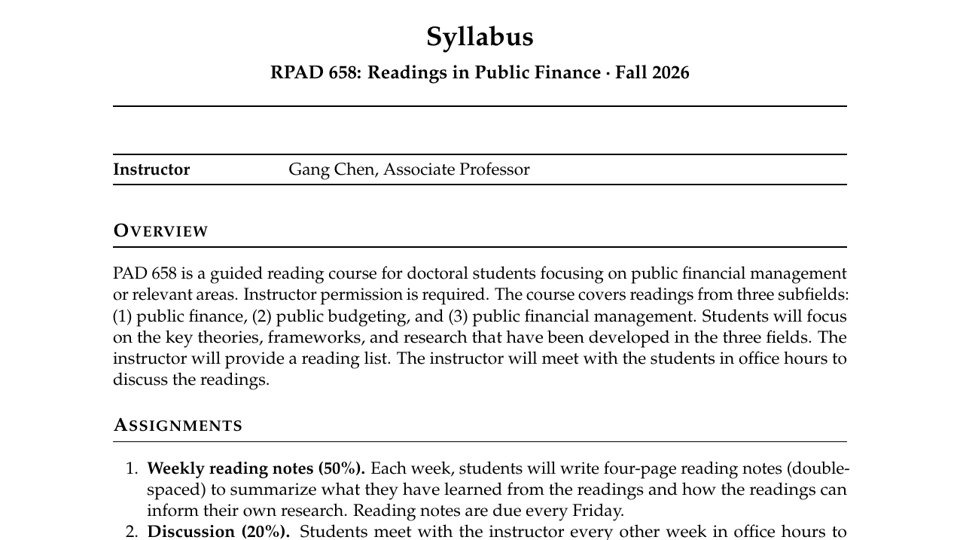
RPAD 658: Readings in Public Finance
A guided reading course for doctoral students in public financial management and related areas. The readings come from three fields:
- Public budgeting: budget theory, incrementalism, budget reform, and fiscal rules.
- Public finance: public goods, fiscal federalism, grants, taxation, revenue, and equity.
- Public financial management: accounting and transparency, debt, capital budgeting, fiscal stress, and pensions.
The fifteen-week reading list pairs classic works with recent research.